|
Everything is Deeply Intertwingled |
|
1836 |
The Telegraph is patented. Morse code is used to send messages over a wire. |
1843 |
The fax machine is patented by a Scottish mechanic named Alexander Bain. Bain used clock mechanisms to transfer an image from one sheet of electrically conductive paper to another. |
1858 - 1866 |
The Transatlantic Cable is completed. Allows instantaneous communications across the Atlantic. |
1876 |
Alexander Graham Bell invents the telephone. Telephone cables and exchanges provide the backbone of the Internet. |
1945 |
Vannevar Bush writes an article in Atlantic Monthly about a photo-electrical-mechanical device called a Memex, for memory extension, which could make and follow links between documents on microfiche |
1957 |
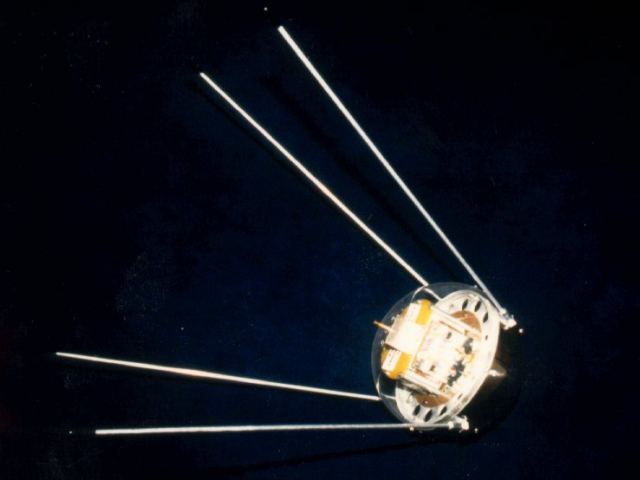
The USSR launches Sputnik, the first artificial earth satellite. In response,the United States forms the Advanced Research Projects Agency (ARPA) within theDepartment of Defense (DoD) to establish US lead in science and technology applicable to the military. |
1964 |
In 1964, RAND issued a dozen reports by Paul Baran (with some collaborators) under the group title On Distributed Communications. Since the late 1950s, Baran had been theorizing on details of a communications system that might survive nuclear attack by shuttling digital data among interconnected computers spread all over the country. "It was the height of the Cold War," Baran recalled of the atmosphere that drove his research at the time. "There were threats going back and forth, and we were entering the Cuban missile crisis. They were crazy times." He said he didn't regard packet switching "as any great achievement." It just happened to be "the only solution I could think of for survivability," he said. |
1965 |
Ted Nelson coins the word Hypertext in A File Structure for the Complex, the Changing, and the Indeterminate. 20th National Conference, New York, Association for Computing Machinery, 1965. Hypertext, at its most basic level, is a DBMS that lets you connect screens of information using associative links. At its most sophisticated level, hypertext is a software environment for collaborative work, communication, and knowledge acquisition. Hypertext products mimic the brain's ability to store and retrieve information by referential links for quick and intuitive access. |
1966 |
Paul Baran: "Around December 1966, I presented a paper at the American Marketing Association called 'Marketing in the Year 2000. 'I described push-and-pull communications and how we're going to do our shopping via a television set and a virtual department store. If you want to buy a drill, you click on Hardware and that shows Tools and you click on that and go deeper." |
1967 |
Andy van Dam and others build the Hypertext Editing System and FRESS in 1967. |
1968 |
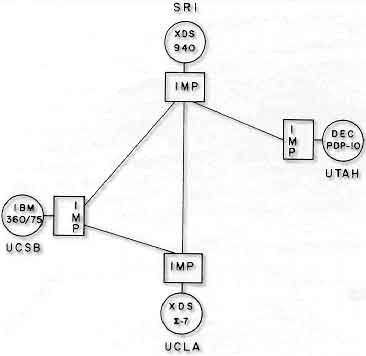
ARPA awarded the ARPANET contract to BBN (Bolt, Beranek and Newman). BBN had selected a Honeywell minicomputer as the base on which they would build the switch. The physical network was constructed in 1969, linking four nodes: University of California at Los Angeles, SRI (in Stanford), University of California at Santa Barbara, and University of Utah. The network was wired together via 50 Kbps circuits.
Backbones: 50Kbps ARPANET - Hosts: 4 |
1968 |
On December 9, 1968, Douglas C. Engelbart and the group of 17 researchers working with him in the Augmentation Research Center at Stanford Research Institute in Menlo Park, CA, presented a 90-minute live public demonstration of the online system, NLS, they had been working on since 1962. The public presentation was a session in the of the Fall Joint Computer Conference held at the Convention Center in San Francisco, and it was attended by about 1,000 computer professionals. This was the public debut of the computer mouse. But the mouse was only one of many innovations demonstrated that day, including hypertext, object addressing and dynamic file linking, as well as shared-screen collaboration involving two persons at different sites communicating over a network with audio and video interface. |
1969 |
The first inter-network communication from UCLA to Stanford. "We set up a telephone connection between us and the guys at SRI...," "Do you see the L?" "Yes, we see the L," came the response. "We typed the O, and we asked, "Do you see the O." "Yes, we see the O." "Then we typed the G, and the system crashed"... |
1969 |
Compu-Serv started. (Name later changed to CompuServe) |
1970 |
The birth of UNIX, the operating system of the Internet. |
1971 |
In 1971 Ray Tomlinson of ARPANET sent the World's first e-mail, by adapting an existing, popular, time-share internal mail program and linking it to the new network file transfer technology that underpinned ARPANET's further activities. The first message was simply addressed to himself, sent from one computer to another, with the text 'Testing 1-2-3'. The next thing he did was to address a message to all ARPANET users explaining the availability of 'electronic mail' and giving instructions on how to address mail to another user using the convention - users' log-in name@ host computer name - which is still the basis of e-mail today. |
1972 |
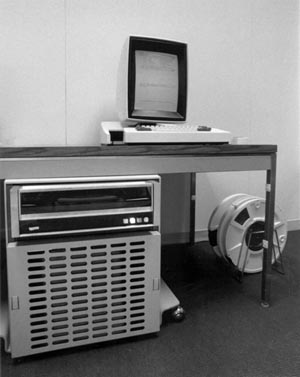
The first "personal computer" that was developed at Xerox PARC in 1973. The Alto was first conceptualized in 1972 in an all points memo written by Butler Lampson. Technically, the Alto was a small minicomputer, but it was a personal computer in the sense of being easier to use than the mainframes and minicomputers of the era and also was the first computer to use the desktop metaphor and graphical user interface (GUI). The Alto had a two-button mouse (see computer mouse) and an optional chord keyset, a device used with SRI's On-Line System that never became popular. The Xerox Alto, like virtually all PARC products, was a commercial failure. |
1974 |
First Use of term Internet by Vint Cerf and Bob Kahn in paper on Transmission Control Protocol.
Backbones: 50Kbps ARPANET - Hosts: 23+ |
1979 |
Robert M. Metcalfe develops Ethernet, which allowed coaxial cable to move data extremely fast. This was a crucial component to the development of LANs.
Backbones: 50Kbps ARPANET, plus satellite and radio connections - Hosts: 111+ |
1979 |
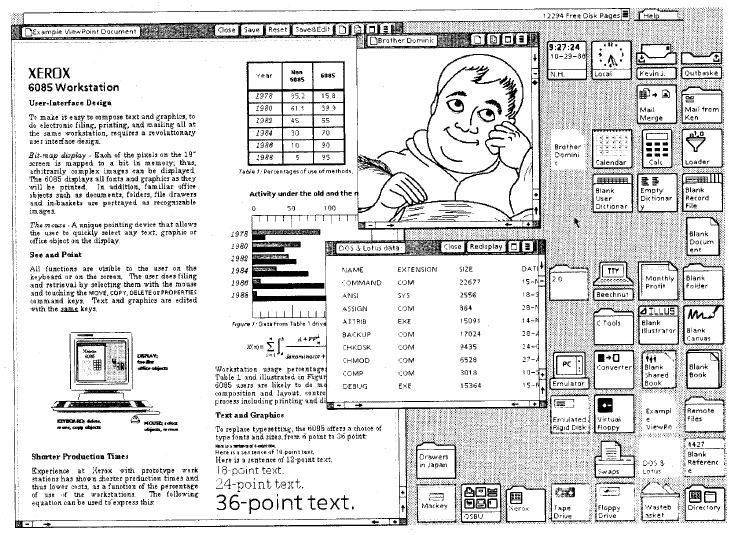
Steve Jobs and a number of Apple engineers visited Xerox PARC in 1979, three months after the Lisa and Macintosh projects had begun. They had been invited by Xerox, an investor in Apple, to see the Xerox Alto and Xerox Star computers, which were pioneers in usable GUI technology. There is debate over the degree of impact that this visit had on Apple's products -- Apple's GUIs ended up working and looking different from the PARC GUIs, and GUIs had been an active area of computing research since the late 1960s -- but it is clear that the Xerox visits were extremely influential on the development of the Lisa and Macintosh. |
1979 |
Usenet came into being in late 1979, shortly after the release of V7 Unix with UUCP. Two Duke University grad students in North Carolina, Tom Truscott and Jim Ellis, thought of hooking computers together to exchange information with the Unix community |
1980 |
While consulting for CERN June-December of 1980, Tim Berners-Lee writes a notebook program, "Enquire-Within-Upon-Everything", which allows links to be made betwen arbitrary nodes. Each node had a title, a type, and a list of bidirectional typed links. "ENQUIRE" ran on Norsk Data machines under SINTRAN-III. |
1981 |
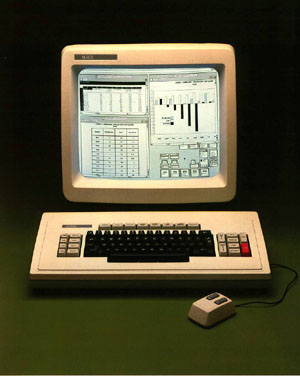
The Xerox Star 8010 was introduced in 1981 and retailed for $16,595. It's unclear how many units were shipped. It featured a menu-driven desktop user interface, icons, mouse, high-resolution graphics on a 17 inch monitor, built in and external storage devices, Ethernet. Software programs included word processing, illustration, paint, email, project management and laser printing. The word processing program Bravo is the precursor to Microsoft Word. |
1981 |
On August 12, 1981, IBM introduced its new revolution in a box, the "Personal Computer" complete with a brand new operating system from Microsoft and a 16-bit computer operating system called MS-DOS 1.0. The "Microsoft Disk Operating System" or MS-DOS was based on QDOS, the "Quick and Dirty Operating System" written by Tim Paterson of Seattle Computer Products, for their prototype Intel 8086 based computer. Microsoft bought the rights to QDOS for $50,000. |
1983 |
The Lisa was first introduced in January 1983 (announced on January 19) at a cost of $9,995 US. It was the first personal computer to have a GUI and a mouse. The first Lisa had two 5.25 inch disk drives (nicknamed the "Twiggy" drive) and ran the Lisa OS as its operating system. It ran on a Motorola 68000 CPU and had 1MB RAM and a 5MB Apple ProFile external hard drive originally designed for the Apple III. It also featured preemptive multitasking, then an extremely advanced feature for a system at this level, but one that was partially responsible for the overall slowness of the system. (The Macintosh did not receive this feature until Mac OS X). Conceptually, the Lisa resembled the Xerox Star in the sense that it was envisioned as an office computing system; consequently, Lisa had two main user modes: the Lisa Office System and the Workshop. The origin of the name Lisa is shrouded in mystery. Some say it is an acronym for Local Integrated Software Architecture, others that it was named after Steve Jobs' daughter, and that the acronym was invented later to fit the name, expanding the acronym to Let's Invent Some Acronym. |
1984 |
The ARPANET was divided into two networks: MILNET and ARPANET. MILNET was to serve the needs of the military and ARPANET to support the advanced research component, Department of Defense continued to support both networks.
Backbones: 50Kbps ARPANET, 56Kbps CSNET, plus satellite and radio connections - Hosts: 1024 |
1984 |
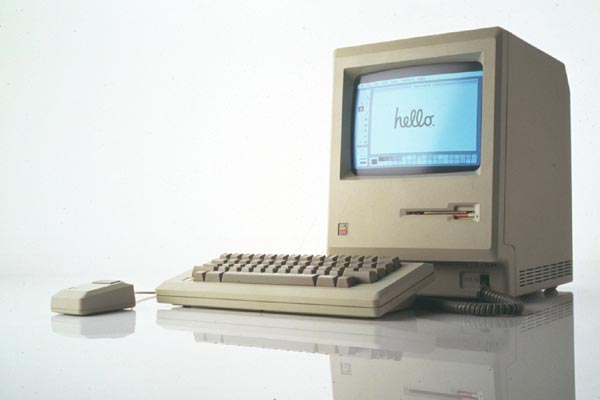
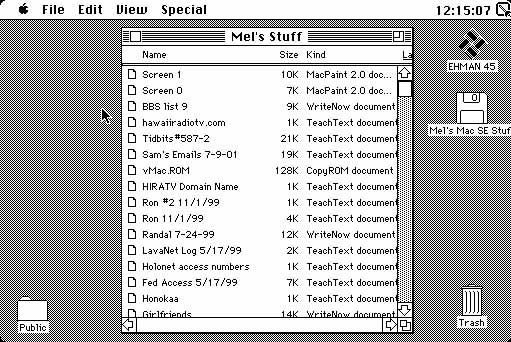
The Macintosh was introduced on January 22, 1984, with a famous Super Bowl commercial featuring a female athlete throwing a hammer through a giant TV screen image of a dictator ("Big Brother", alluding to the tyrant character of the novel Nineteen Eighty-Four, and vaguely reminiscent of the dominant computer maker at that time: IBM). The Mac went on sale two days later for a price of $2,495.00. It featured a graphic user interface and a mouse, there was no command line access to programs. |
1985 |
Microsoft introduces Windows 1.0. It was essentially a front-end to the MS-DOS operating system. |
1985 |
Charles Schwab introduces Equalizer online investing software and SchwabQuotes touch-tone quote system. Launches standalone Financial Independence software for managing personal finances on the PC. |
1987 |
Microsoft introduces Windows 2.0. Still a front-end to the MS-DOS operating system, among other innovations windows could overlap. |
1987 |
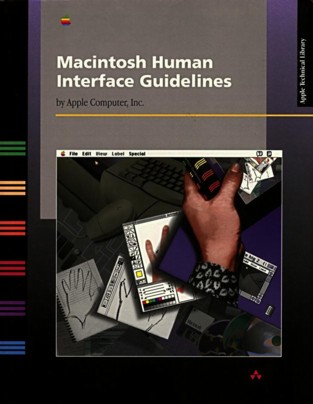
Apple publishes the Apple Human Interface Guidelines. The Macintosh interface design language included visual and syntactic details, such as the names of standard menu items, and deeper functional elements, such as the use of a clipboard with universal cut, copy, and paste commands to be provided in a standard way in every application. |
1987 |
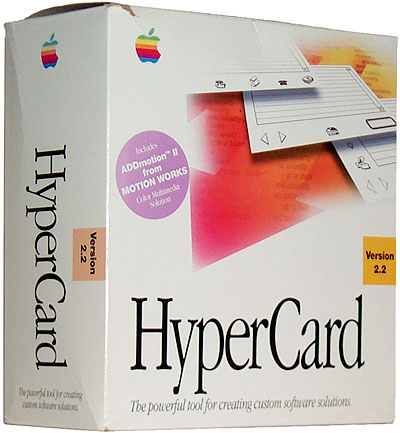
HyperCard was created by Bill Atkinson and initially released in 1987,with the understanding that Atkinson would give HyperCard to Apple only if they promised to release it for free on all Macs. Originally called WildCard during its development, the name was changed to HyperCard before official release due to legal issues. The Hypercard concept is actually now familiar as it is essentially that of the World Wide Web, albeit confined to a single machine. In this respect it may be another example of being too far ahead of its time - had it been a network-based system from the start, the story of the internet may have been very different. |
1987 |
Apple gives Steve Case the go-ahead on an online service to be called AppleLink personal edition. |
1988 |
The birth of Internet Relay Chat (IRC) a precursor of today's chat programs |
1989 |
AppleLink changes name to America Online a service offered through Quantum. |
1989 |
Elwood Edwards records, "Welcome", "You've got mail", "File's done", and "Goodbye." |
1990 |
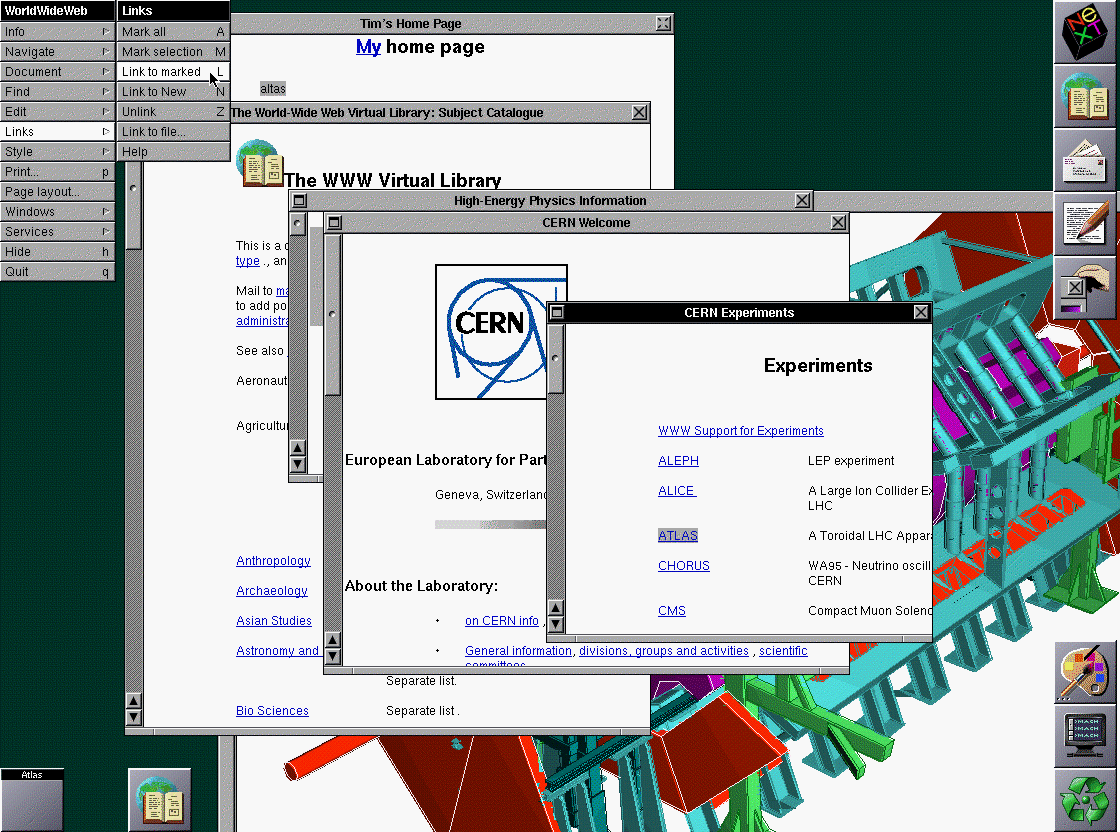
Tim Berners-Lee starts work on a hypertext GUI browser+editor using the NeXTStep development environment. He makes up "WorldWideWeb" as a name for the program. (See the first browser screenshot) "World Wide Web" as a name for the project (over Information Mesh, Mine of Information, and Information Mine).
300,000 Hosts. 1,000 News groups |
1990 |
Archie, developed at McGill University (Montreal) first search engine for finding and retrieving computer files. At the time these large institutional computers placed their data and program files into two categories: open and closed. When you 'logged-in' to another computer, you could access the open' files by identifying yourself as "anonymous" and using your e-mail address as the password. Then you could browse through their archive and download any files you wanted. |
1991 |
World-Wide Web (WWW) released by CERN; Tim Berners-Lee developer (:pb1:). First Web server is nxoc01.cern.ch, launched in Nov 1990 and later renamed info.cern.ch. |
1991 |
Gopher released by Paul Lindner and Mark P. McCahill from the U of Minnesota. A text-based menu driven application to access internet resources. No need to remember command-line commands. Within 'gopherspace' search-engine called Veronica (supposedly Very Easy Rodent-Oriented Network Index to Computerised Archives), developed at the University of Nevada operated on the same principle as Archie but it also allowed you to distinguish between a search for 'directories' and an undifferentiated search combining directories and files (the latter was much larger and time-consuming). Again, having located something, you e-mailed it to yourself. |
1992 |
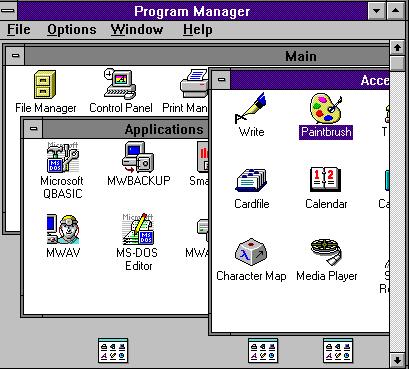
Microsoft launches Windows 3.1. This is a substantial improvement on previous MS-DOS front-ends. It includes some multimedia capability and True Type fonts. |
1992 |
The term "surfing the Internet" is coined by Jean Armour Poll. |
1992 |
In 1992, E*TRADE Securities, Inc., one of the original all-electronic brokerages, was born and began to offer online investing services through America Online and CompuServe. |
1993 |
Mosaic, the first widely available Web Browser created by Marc Andreesson.
Number of Hosts 2 Million. 600 WWW sites. |
1993 |
Charles Schwab introduces StreetSmart online trading system replaces Equalizer. |
1994 |
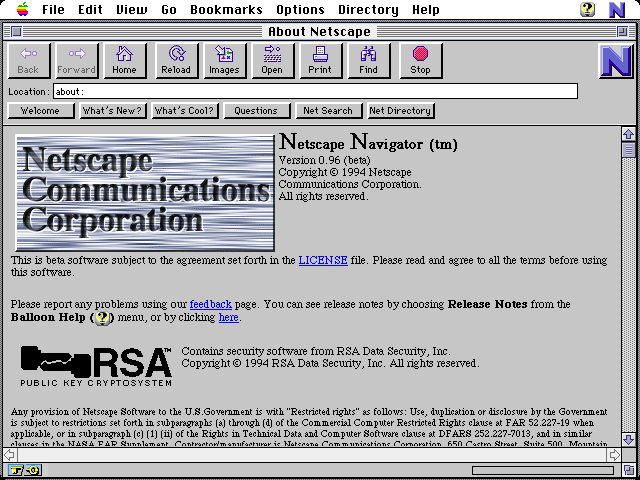
The Netscape Navigator Browser is released in final Beta -- for the first time it is called Netscape rather than Mosaic. Within a year and a half there were more than 65 million users of the Netscape browser. |
1994 |
Commercialisation of the Internet begins. US Senate and House provide information servers. You can order pizza from Pizza Hut online in the U.S.
Number of Hosts 3 Million. 10,000 WWW sites. 10,000 News groups. |
1994 |
Yahoo! (supposedly an anachronym for 'Yet Another Hierarchical Officious Oracle' but this is now denied by its creators) is a commercial directory established in late 1994 by two PhD students at Stanford University (David Filo and Jerry Yang, who also developed the software) |
1995 |
Sun launches JAVA on May 23
Microsoft launches Internet Explorer 1.0 |
1995 |
Amazon.com launched. |
1995 |
AltaVista (meaning 'view from above') opened in December 1995 as an offshoot of Digital Computers. It has an index to 550 million web-pages, divided into 24,000 categories. It was also the first site to include a translation service (the same one behind some of our history web-sites) and a search facility for images and sound files. |
1996 |
Internet phones catch the attention of US telecommunication companies who ask the US Congress to ban the technology (which has been around for years |
1996 |
E*Trade launches web-based trading. |
1996 |
Charles Schwab launches Internet trading calling it e.Schwab. |
1997 |
Microsoft releases Internet Explorer 4.0, in the first 24 hours it was available it was downloaded once every 6 seconds. |
1998 |
The size of the Web is estimaged to range between 275 (Digital) and 320 (NEC) million pages for |
1998 |
Google was formed by two Stanford graduates in April 1998. The principle behind it was that it monitors other indices to see who links to what (and to rank these) in order to locate the real 'authorities' on a topic and it uses this to rank the results. It had superb, clean looks and it now also has the largest coverage of any search engine. |
2000 |
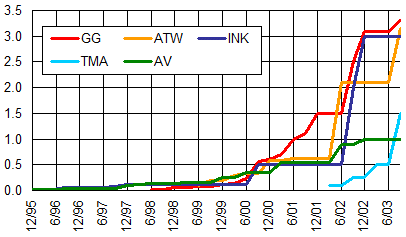
The size of the Web is estimated by NEC-RI and Inktomi to surpass 1 billion indexable page
The US timekeeper (USNO) and a few other time services around the world report the new year as 19100 on 1 Jan |
2003 |
Google indexes more than 3 Billion visible pages on the World Wide Web for their search service. |
2003 |
The Recording Industry Association of America (RIAA) sues 261 individuals on 8 September for allegedly distributing copyright music files over peer-to-peer networks |